
Outdoor sights
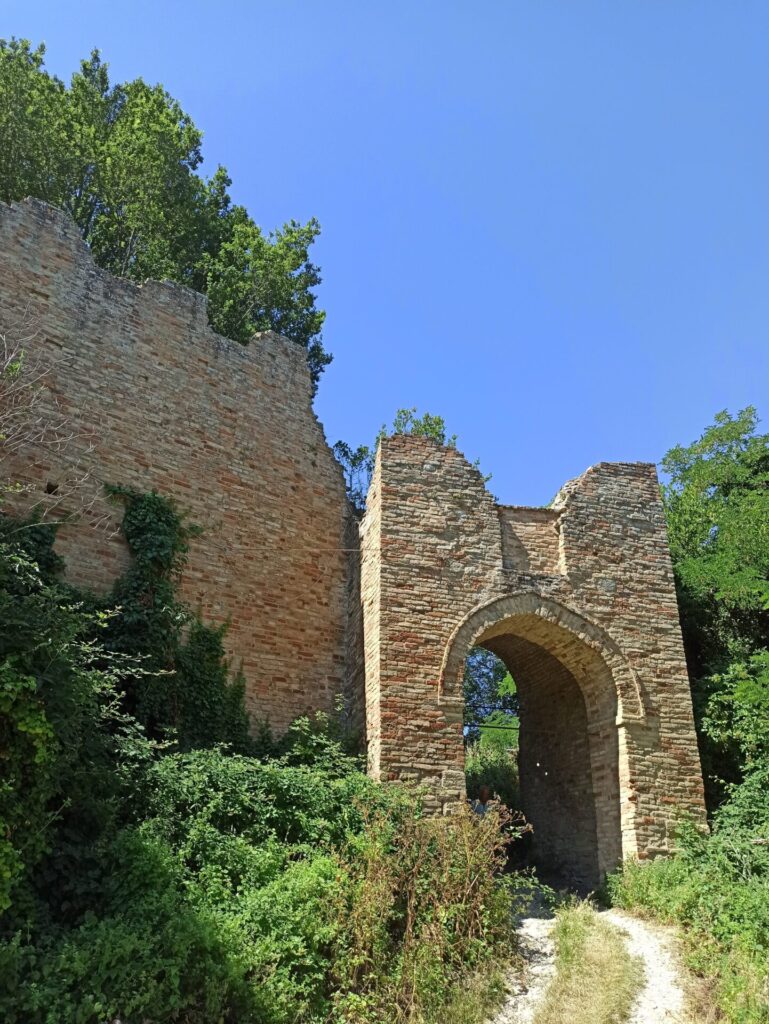
Ancient walls
To the west of the residential area, it can be seen a wide ring of walls that includes a vast space free from urban construction and with great landscape value. Between 1433 and 1446, Francesco Sforza reinforced, enlarged and provided the existing fortifications with bulwarks. The city walls were equipped with: Cassero (the Keep), the only one of which some traces of the foundations remain in the external basement area of the Palazzo Secreti; the Girone, a section of the wall that ran from Porta del Pero to Porta Sant’Andrea; and Rocca Coccaro where the present-day Parco Pubblico di San Rocco is located.
At the end of 1896, the perimeter of the walls was 1553 meter long, with the presence of 11 towers.
In the southern part of the village – the part that formerly descended to the valley of the Aso River – there is Porta San Basso, known by the villagers as Porta Vecchia.
Two other entrances to the village were Porta del Pero to the north, on the road to Fermo, and Porta Sant’Andrea to the west, in the direction of Petritoli, which constitute the remains of the ancient city walls.
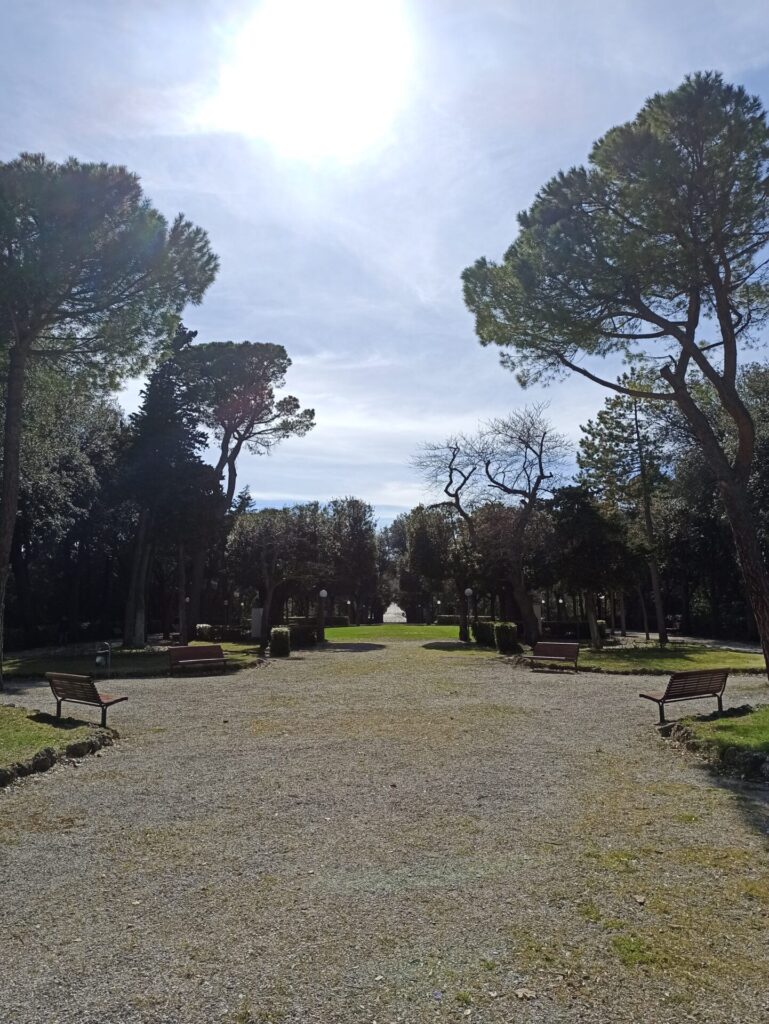
The “Giacomo Leopardi” public gardens– Parco San Rocco
The historic Parco San Rocco is an Italian-style park that occupies a large area north of the historic center. Its construction began in 1892 when, in order to create a suitable area, the Coccaro Hill was leveled with the help of all villagers who, with just basic tools, carried out an extraordinary earth-moving job. The brave architect who led such a colossal initiative was Luca Galli, a professional from Monterubbiano who also masterfully oversaw the construction of the Monumental Cemetery and the Teatro Pagani.
The park is characterized by a pleasantly crisp air in the summer and a soothing silence that give visitors moments of tranquility and peace. The predominant tree species is the holm oak, which gives year-round green emerald color. There are also pines of various species, limes and Judas trees. The park is home to avifauna and several specimens of red and gray squirrels. Inside the gardens there are several busts, mostly bronze ones, portraying illustrious figures from Monterubbiano (scientists, artists, scholars) who have excelled in their specific profession thus honouring their birthplace. Among the busts inside the park are those of: Luca Galli, architect; Eugenio Centanni, physician; Oreste Murani, physicist; Temistocle Calzecchi Onesti, physicist; Stefano Mircoli, physician; and a stone with a sonnet written by Luigi Centanni.
In the part below the park, on the west side, there is a refreshment area including a drinks and food stall and a children’s playground area with a soccer field.
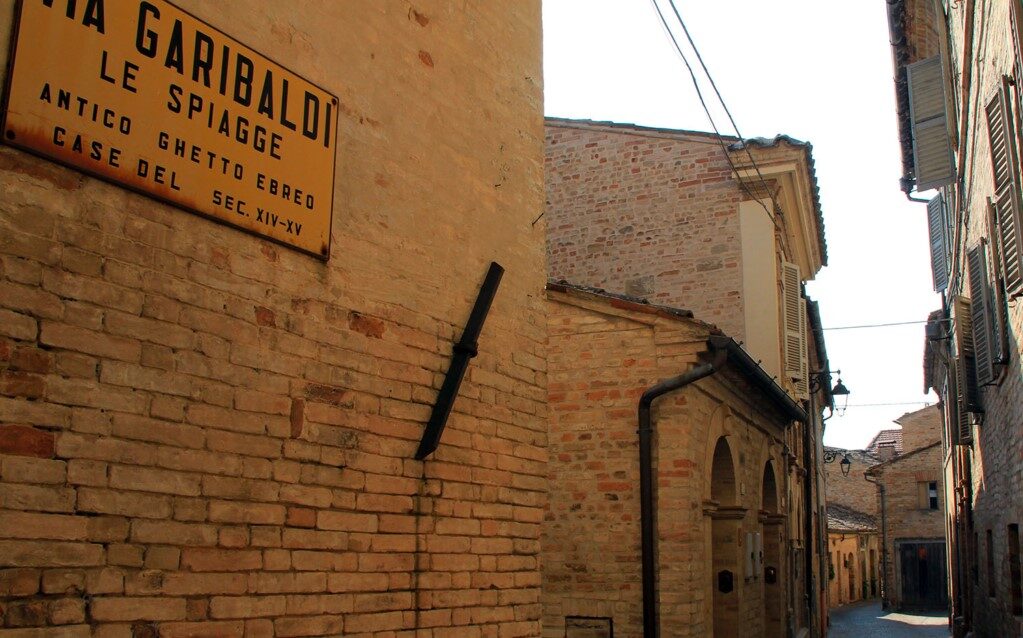
The Jewish Ghetto
Walking south along the central square Temistocle Calzecchi Onesti, you will get to the Jewish Ghetto.
This area is called “Le Spiagge” (The Beaches”) by the people of Monterubbiano as it is bathed in sunlight for much of the day. A Jewish community, one of the most important in the Fermo area, has been settled in this area since the 13th century.
At that time, the dwellings and stores were all connected by underground passages that are only partially accessible nowadays. It is possible to see the architectural remains of a synagogue, for the presence on the wall of such a wide arch so as for it to be identified as the gateway to a sacred place. The profitable businesses run by the Jews of Monterubbiano were textile manufacturing and tanning.
In the first half of the sixteenth century a serious financial crisis hit the town so much so that, in order to overcome it, the Municipality got into debt with the Jews and had to sell a land to the neighboring municipality of Montefiore dell’Aso to pay it off. It was September 6, 1547, and the river became the natural border between the two towns.
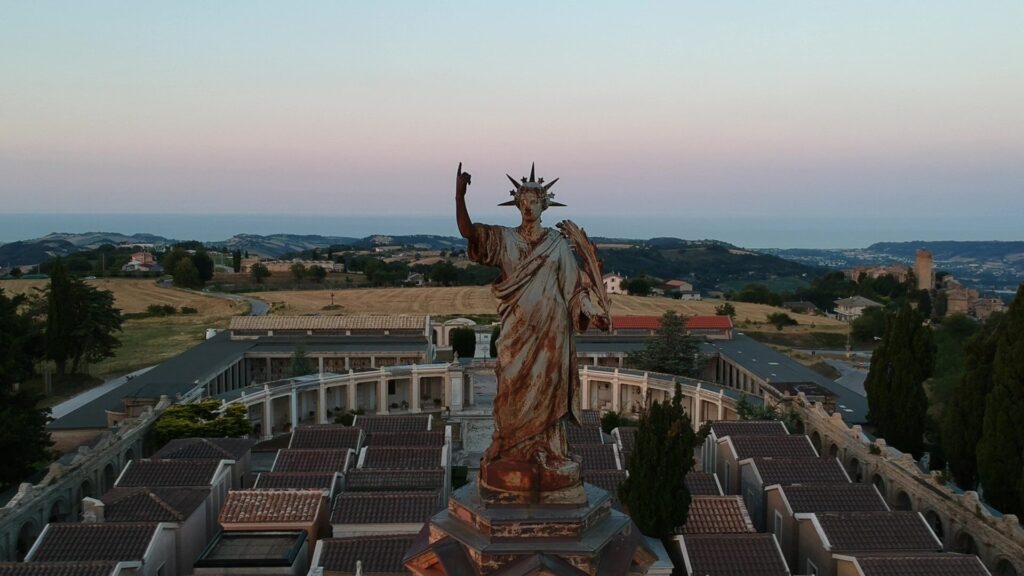
Monumental Cemetery
n 1875, considering the state of neglect of the municipal cemetery and its noncompliance with the new legal provisions, the pre-existing structure was adapted based on a proposal by architect Luca Galli.
The cemetery is built on a longitudinal axis of symmetry that divides the porticoed courtyard on the two major sides. On the smaller side there is the entrance with a classical Doric-style pronaos raised above the street.
The other facade, facing inward, encloses the rectangular perimeter. The central chapel re-proposes the entrance pronaos with the half-columns leaning against the masonry serving as pilasters. The chapel is topped by a lantern that serves as a pedestal for a cast iron statue representing the allegory of Immortality, 280 cm high, made by sculptor Nicola Ceprelli from Fermo. The statue was made by the workshops of the Montani Technical Institute in Fermo and is coeval with the initial design.
From this original unit, the cemetery underwent some extension work starting in the 1920s, in the immediate postwar period, and in the 1960s, until it became what it is today.


